
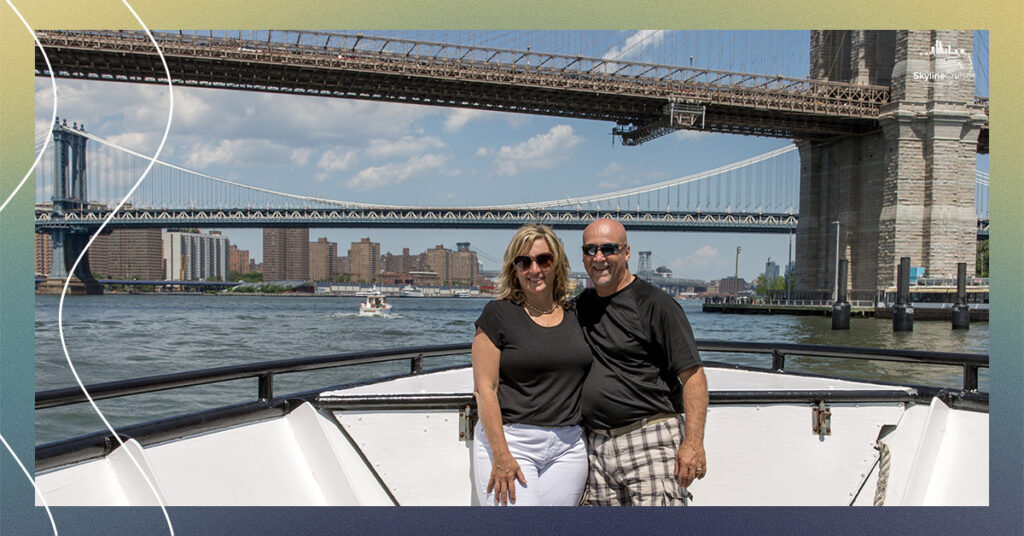
Some settings hand you a great photo without any effort. New York Harbor at sunset is one of them. The moment the Skyline Princess pulls away from the dock, and the Manhattan skyline opens up in front of you, you’ll understand why so many guests come aboard with a camera — or at least pull out their phones and refuse to put them down.
Whether you’re a hobbyist with a mirrorless camera, a couple hoping for a few frame-worthy shots together, or simply someone who doesn’t want to miss the moment the Statue of Liberty glides into view… this guide is for you! We’ve been sailing NY Harbor for more than 30 years, and we’ve seen every kind of photographer. Our photo gallery gives you a preview of what’s waiting for you out on the water, and with a little preparation, your shots can look like they came straight from a travel magazine.
If you’re planning a group event and want your gathering to be just as photogenic as the scenery, check out our 10 tips for a memorable night aboard the Skyline Princess before you book.
Table of Contents
How to Take Good Photos on a Dinner Cruise
The most common question people ask before they board is how to take good photos on a dinner cruise — especially at night, when the lights of the skyline are reflected across the water and everything feels impossibly cinematic. The key difference from shooting on land is motion. Even on a calm evening, the boat moves, and that movement is the enemy of a sharp image.
Here are the adjustments that make the biggest difference:
- Use burst mode. Most smartphones and digital cameras have a burst or continuous shooting setting. Use it. When you fire off five frames in quick succession, at least one will be sharp, even if the boat shifts slightly beneath you.
- Stabilize when you can. Rest your elbows on the railing, lean against a wall, or brace your camera against a fixed surface. The Skyline Princess has three decks with ample railing — use them. The Skylight Deck is best for sweeping panoramic shots; the lower decks offer a steadier platform for portraits and close compositions.
- Raise your ISO at night. Indoors or after dark, bump your camera’s ISO to 800–1600 to compensate for lower light without slowing your shutter speed too much. Motion blur is your biggest risk, and a higher ISO helps keep your shutter moving fast.
One tip that applies to any shooting environment: turn off your flash for distance shots — it won’t reach the skyline, and it will flatten whatever’s in the foreground. The ambient light of the harbor and the city is almost always more flattering anyway.
Golden Hour on the Water — The Light You’ve Been Waiting For
Photographers obsess over golden hour for good reason. In the roughly 60 minutes before sunset, the light turns warm, directional, and flattering in a way that midday sun simply cannot match. On the water, it’s even more dramatic — the harbor becomes a mirror, the skyline seems to glow from within, and every photo you take looks like it was planned.
Our evening dinner cruises are timed beautifully for it. We head out into the harbor just as the sun begins its descent, which means you don’t have to do a thing except be ready. Golden hour light reduces harsh shadows and enhances warm color tones in outdoor photography.
Position yourself on the Skylight Deck — our open-air rooftop level — for the most unobstructed view of the horizon as the sun drops. The warm tones against the steel and glass of Manhattan’s skyline create a contrast that’s nearly impossible to reproduce in any other setting. If you’re shooting portraits, face your subject toward the light. Those soft amber tones do all the work.
How to Take Better Photos by the Water
Water as a backdrop does two things instantly: it adds depth, and it doubles your subject. A sharp reflection of the Brooklyn Bridge across a calm harbor can be just as striking as the bridge itself. Learning to use that to your advantage is what separates a good harbor photo from a great one.
Shoot low when you can. Getting your camera closer to the water’s surface — even by just a foot — emphasizes the reflection and gives your shots a more dramatic, editorial feel. From the rail of the second deck, you can often find this angle without difficulty.
Look for leading lines. Using leading lines in photography draws the viewer’s eye toward the main subject. The wake of the boat, the edge of a dock, or the curve of a bridge cable can all direct the eye toward your main subject — the skyline, the Statue of Liberty, a friend laughing in the foreground.
On overcast days, don’t pack the camera away. Flat light on the water tends to minimize glare and even out exposure, making it easier to capture detail in both the foreground and the distant skyline. Some of the most compelling NY Harbor photography is shot under gray skies, when the reflections are subdued and the city feels close.
Iconic Landmarks Along the NYC Cruise Route
New York Harbor is one of the most photographed bodies of water in the world, and it earns every shot. The Skyline Princess sails past a remarkable collection of iconic landmarks and historic buildings — some recognized instantly across the globe. Here’s what to expect along the route, and how to make the most of each moment.
The Statue of Liberty
She comes into view gradually — first as a small silhouette on the horizon, then as the full, unmistakable form of Lady Liberty. Most guests on public dinner cruises spot her off the starboard side as we head out into the harbor. The Statue of Liberty stands 305 feet tall from the base of its pedestal to the torch tip.
The best approach for a photograph is patience. Wait until she fills more of your frame before shooting — closer is almost always better. Include a bit of water and sky around her for context. If you can get a person in the foreground, do it. That sense of scale makes the difference between a snapshot and a photograph worth framing.
The Brooklyn Bridge — And Which Side Is Best for Photos?
This question comes up often: which side of the Brooklyn Bridge is best for photos? The Brooklyn Bridge spans 1,595 feet and is one of the oldest suspension bridges in the United States. In the afternoon and evening, the western face catches the warm light best. When the Skyline Princess passes alongside the bridge, the perspective from the lower decks is low and dramatic — a view you simply cannot get from the shore.
The Gothic stone towers and the intricate web of steel cables make the Brooklyn Bridge a subject that rewards patience. Let a few frames go and wait for the composition to tighten as the boat moves through the water.
The Manhattan Bridge and the Historic NYC Skyline
The Manhattan Bridge doesn’t get the same spotlight as its famous neighbor, but photographers who look for it are rarely disappointed. The Manhattan Bridge opened in 1909 and features distinctive Beaux-Arts towers at its entrances. Its deep blue paint and industrial profile contrast beautifully with the modern skyline rising behind it.
From the water, both bridges can often be framed together in a single wide shot — a composition that captures a century of New York engineering in one frame. On land, that perspective is nearly impossible to achieve. The NY Harbor gives you the distance. Use it.
Common Photography Mistakes to Avoid
Even seasoned photographers make a few classic missteps when shooting from a moving vessel. Knowing them ahead of time saves you from discovering the problem when you get home and flip through your shots.
The most common mistake is over-relying on automatic settings. Your phone or camera is making educated guesses about what you want to photograph, and it often misjudges when light is mixed — bright sky, dark water, and artificial interior light all in one frame. Take a moment to tap your main subject on your screen before shooting; most smartphones allow this for manual focus and exposure.
A close second: centering every shot. The rule of thirds improves composition by placing subjects along off-center grid lines. Placing your horizon at the midpoint cuts the image in half and flattens it. Position it at the lower or upper third instead — more sky for drama, more water for reflection.
Finally, don’t wait until the best moments have passed. The departure from the dock, the first glimpse of the Statue of Liberty, the golden hour light before dinner — these don’t last long. Keep your camera accessible and resist the urge to review each shot in the moment. Shoot first, curate later.
How to Take the Perfect Photo on a Cruise
There’s no single formula, but a few principles apply across every camera, every cruise, and every skill level.
Light matters more than gear. A well-timed shot on a smartphone at golden hour will almost always outperform a technically perfect photo taken at noon with a professional camera. Time your best shots for the first and last hour of light, and the harbor will do the rest.
Composition matters more than resolution. Think about what’s in the frame, not just what you’re pointing at. The skyline, a bridge, the Statue of Liberty, a smiling guest — these are your subjects. Everything else is context. Simplify when you can, and step back before you assume you’re close enough.
And presence matters most of all. The best photograph you’ll take aboard the Skyline Princess might be the candid one — someone laughing at the dinner table, a couple watching the NYC skyline in silence, a group raising a glass as the city lights come on. New York Harbor gives you the backdrop. What you do with it is entirely up to you.
Come Aboard and Snap Incredible Photos on the Skyline Princess
When you’re ready to step aboard, we’re ready to welcome you. The Skyline Princess is a three-deck private yacht designed for groups of every size and every budget — whether you’re celebrating a milestone with up to 400 guests or reserving a private deck for an intimate evening with a handful of close friends. Every event can be hosted as a full-ship private charter, a private deck on a public cruise, or a group of reserved tables. We accommodate it all. Spots fill up fast, especially during summer evenings when the harbor is at its most beautiful. Reach out and book your cruise today.
If this was useful, tell Google you want more of it.